
Software Development
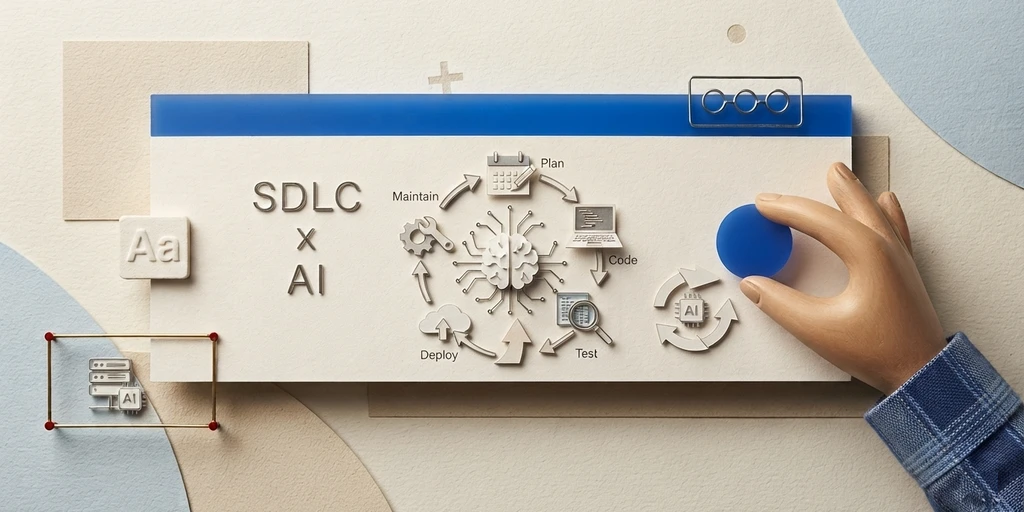
Traditional SDLC models were built for a world where humans wrote every line, reviewed every pull request, and moved through phases in sequence. That assumption is gone. According to GitHub's 2025 Octoverse report, 80% of new developers now use Copilot within their first week on the platform - AI assistance isn't an advanced technique anymore, it's the default starting posture. The teams still running phase-by-phase handoffs the old way aren't just slower; they're solving a different problem than the ones who've already restructured around AI.
The Software Development Life Cycle breaks a project into stages: requirements gathering, system design, development, testing, deployment, and maintenance. How teams move through those stages depends on the model.
The Waterfall model runs them in strict sequence - each phase closes before the next opens, with limited room to revisit earlier decisions. Agile methodology replaced that rigidity with iterative development: short cycles, continuous feedback, and scope that adapts as understanding improves. Scrum is the most common Agile implementation, organizing work into sprints with defined roles and ceremonies.
Both models assume a mostly human bottleneck at every phase — a person writing the requirements doc, a person designing the schema, a person writing and reviewing code. AI is dismantling that assumption. It doesn't remove the phases. It changes how much human time each one consumes, and DORA's 2025 State of AI-assisted Software Development report - based on nearly 5,000 technology professionals - found that higher AI adoption is associated with a rise in throughput and a rise in delivery instability. Speed and risk are moving together, which is exactly why the old phase-by-phase time allocations no longer hold.
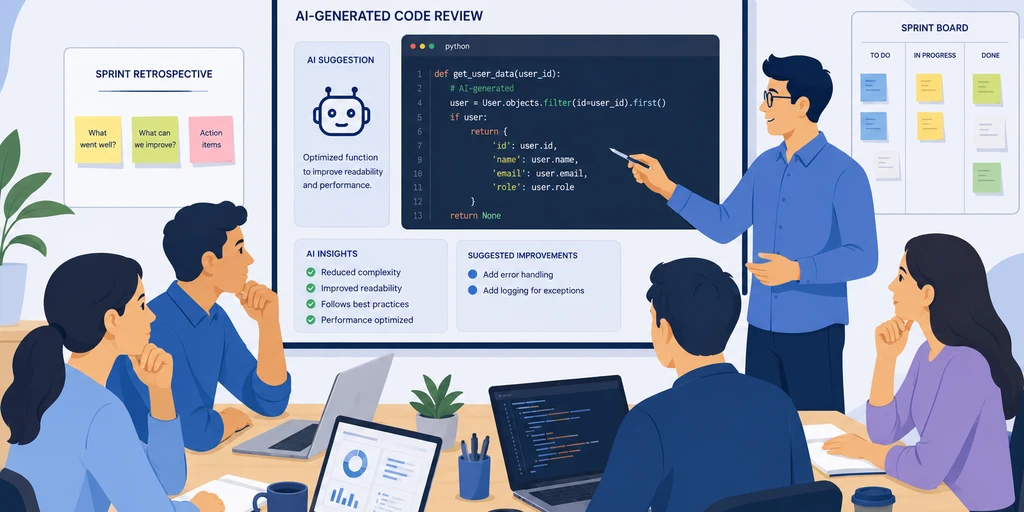
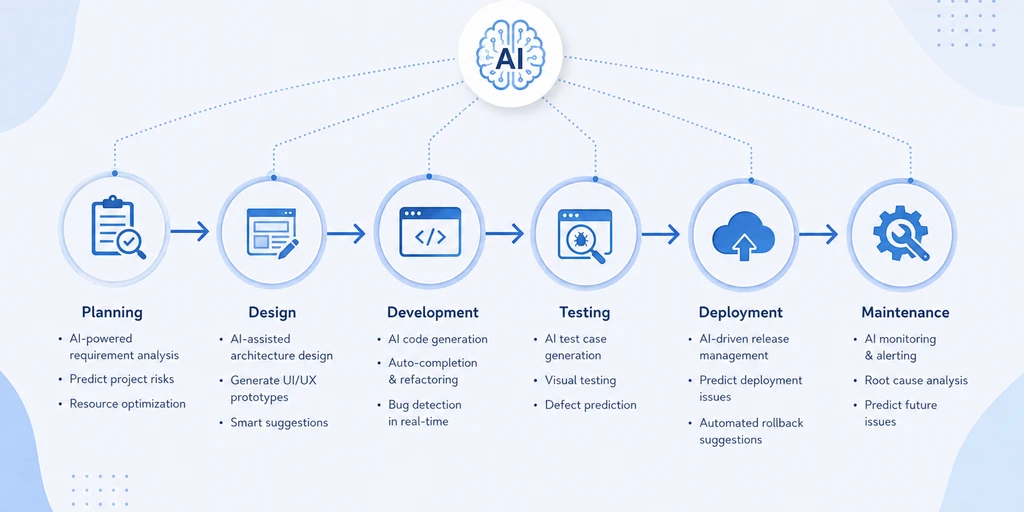
AI isn't arriving as one tool bolted onto the end of the pipeline. It's showing up inside each phase, doing different work in each one.
None of this replaces the phases. It compresses some and expands others - which is exactly why bolting AI tools onto an unmodified SDLC tends to create new bottlenecks instead of removing old ones.
Yes - and AI arguably strengthens Agile more than it strengthens Waterfall. Agile's core premise is short feedback loops, and AI shortens the loop further: a developer can generate, test, and revise a working slice of functionality within a single sprint session instead of a single sprint. Scrum ceremonies still matter, but the unit of work moving through them gets smaller and faster.
Waterfall has a harder problem. Its value depended on getting requirements and design right upfront, precisely because revisiting earlier phases was expensive. AI removes some of that expense — a design can be regenerated cheaply — but Waterfall's governance model isn't built to absorb that kind of continuous revision. Teams still running Waterfall on AI-augmented codebases tend to end up with Agile behavior inside a Waterfall reporting structure, which creates friction rather than removing it.
The honest takeaway: some regulated, fixed-scope engagements still fit Waterfall. But for most product-driven software development, Agile absorbs AI's speed gains cleanly, and Waterfall doesn't.
Speed without guardrails creates new categories of technical debt. AI-generated code that passes tests can still encode subtle architectural inconsistencies that surface months later, and teams that skip review discipline because "the AI already checked it" are trading short-term velocity for long-term maintenance cost.
The data backs this up. Recent aggregated survey data across Stack Overflow, GitHub, and Veracode shows AI tool adoption above 84% among developers, while trust in AI-generated code accuracy has actually declined — more developers now report distrusting AI output's accuracy than trusting it, and less than half of AI-generated code is typically accepted without modification. That gap is the whole argument for keeping human review central to the SDLC rather than optional.
Over-reliance is a related risk. When AI code review becomes the default first pass, junior engineers get less exposure to the reasoning behind design decisions - skill atrophy that only becomes visible when something breaks and nobody on the team can explain why the original approach was chosen. Data privacy deserves its own line item too: feeding proprietary code, credentials, or customer data into public AI models — even accidentally, through IDE autocomplete — is a real exposure path security teams are still catching up to.
In practice, AI-augmented teams look smaller and move faster, but not because AI replaced anyone outright. A team that once needed a dedicated QA engineer, a junior developer for boilerplate, and a solutions architect for every new module can now cover more ground with the same headcount — freeing budget for harder problems instead of routine ones.
Human oversight concentrates at specific gates rather than spreading evenly across every task: architecture decisions, security-sensitive code, and anything customer-facing still get a human sign-off before shipping. Everything routine — scaffolding, test generation, first-draft documentation — runs through AI first and gets reviewed, not rewritten from scratch.
For a firm delivering custom softeware development, this shift shows up directly in project timelines: discovery and prototyping compress, while architecture review and security testing get more deliberate time, not less. That discipline holds whether the engagement runs through Node.js development or Java development services — the stack changes, the review gates don't.
Q. Does AI replace developers in the SDLC?
A. No. AI handles routine, repetitive work - boilerplate, test generation, first-draft documentation - but architecture decisions, security review, and complex debugging still need experienced engineers.
Q. Which SDLC phase benefits most from AI right now?
A. Development and testing show the most visible gains, since AI pair-programming and automated test generation are the most mature tools. Planning and maintenance are catching up as NLP and observability tooling improve.
Q. Is Agile compatible with AI-driven development?
A. Yes, and it fits better than Waterfall. Agile's short feedback loops absorb AI's speed gains naturally, while Waterfall's upfront-heavy governance model struggles to accommodate the continuous revision AI makes cheap.
Q. Does AI eliminate the need for a formal SDLC?
A. No. AI changes how much time each phase takes, but the phases themselves - planning, development, testing, deployment, maintenance - still exist and still need explicit ownership.
AI isn't replacing the SDLC - it's redistributing where human judgment matters most inside it. DORA's research calls AI an amplifier: it makes strong review discipline stronger and weak processes weaker, faster than before. The teams pulling ahead aren't the ones using the most AI tools; they're the ones who've decided deliberately where AI runs unsupervised and where a person still has to sign off. If your team is figuring out where that boundary should sit for your codebase, Techtonic's engineering team can walk through it with you.