
Software Development
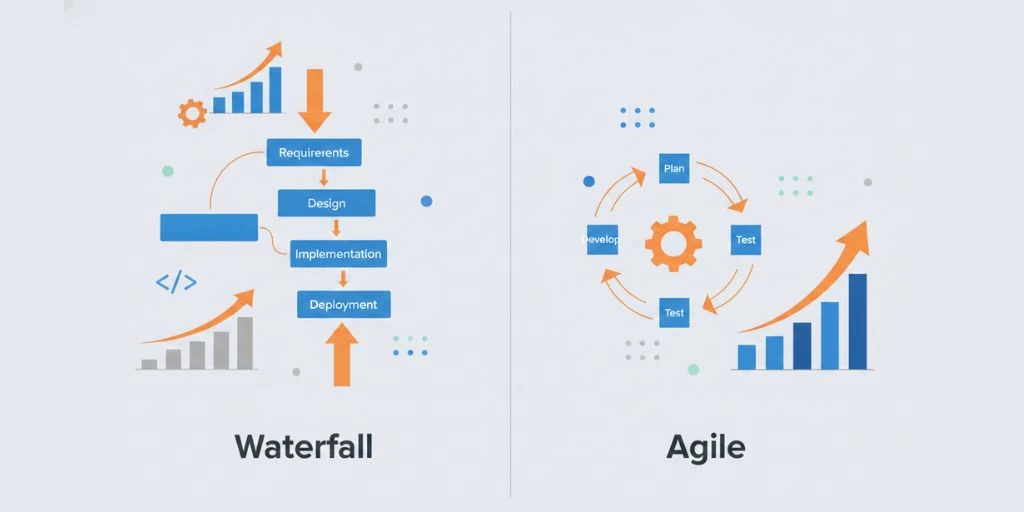
Choosing the wrong development methodology doesn't just slow your project — it can quietly drain your budget, frustrate your team, and deliver software that no longer matches what your business needs. The Agile vs Waterfall debate has been central to software project planning for decades, and for good reason: the choice shapes everything from timelines and cost structures to how much control you retain as a client.
If you're evaluating a software development partner or planning your next build, this guide cuts through the noise and helps you make a decision grounded in your actual project requirements.
The Waterfall model is a linear, sequential approach to software development. Each phase — requirements, design, development, testing, deployment — must be completed before the next begins. Think of it as a relay race: the baton passes in one direction only.
Waterfall gained traction in the 1970s, largely borrowed from manufacturing and construction disciplines where late-stage changes are catastrophically expensive. In those industries, the model works well. In software, where requirements evolve and user feedback reshapes priorities, it shows its age quickly.
The core limitation is rigidity. Once requirements are locked and development begins, incorporating a change means restarting or reworking multiple phases. For long-cycle projects, this creates a dangerous gap between what was specified at the start and what users actually need at delivery.
Waterfall does remain effective in specific contexts — regulated industries like aerospace or medical devices, government contracts requiring extensive upfront documentation, and projects where requirements are genuinely fixed and well-understood before a single line of code is written.
Agile is an iterative development philosophy built around short cycles called sprints (typically two to four weeks). Rather than delivering a finished product after months of silent development, Agile teams release working increments of software at regular intervals.
The 2001 Agile Manifesto formalized what many developers already knew: software is not like building a bridge. Requirements shift. Business priorities change. Users discover what they actually want by interacting with early versions. Agile was designed to accommodate this reality rather than fight it.
Key Agile frameworks include Scrum, Kanban, and SAFe (Scaled Agile Framework). Each has different mechanics, but all share the same core commitments: continuous delivery, close collaboration between development teams and stakeholders, and the ability to respond to change without triggering a full project reset.
According to the 15th Annual State of Agile Report (Digital.ai, 2021), 94% of organizations reported practicing Agile in some form - though adoption depth and discipline vary widely between teams.
Agile vs Waterfall: A Direct Comparison
Factor | Agile | Waterfall |
Project structure | Iterative sprints | Sequential phases |
Flexibility | High — changes welcome mid-project | Low — changes are costly after phase closure |
Client involvement | Continuous throughout development | Heaviest at start and end |
Delivery | Incremental working software | Single final release |
Documentation | Lighter, just-in-time | Extensive and upfront |
Risk management | Early detection via sprints | Risks surface late, near delivery |
Best for | Evolving requirements, digital products | Fixed-scope, regulated, hardware-dependent builds |
Cost predictability | Harder to estimate total cost upfront | Easier to scope and quote |

No single row in this table determines the right choice. It's the combination of your project type, team structure, budget confidence, and tolerance for change that matters.
E-commerce platforms, SaaS dashboards, customer portals — these products live and die by user adoption. User behavior data, A/B test results, and real-world usage patterns will reshape your priorities within the first few weeks post-launch.
Agile wins here. The ability to release early, gather feedback, and iterate in subsequent sprints is not a nice-to-have - it's the mechanism that separates products that find product-market fit from those that don't.
Imagine a compliance reporting tool for a financial institution where every requirement is dictated by regulation, documented in a 200-page spec, and cannot deviate. Scope won't change. Auditors need a paper trail at every phase.
Waterfall fits here. The sequential structure, heavy documentation, and phase-gate approvals align with what the project and its stakeholders require.
Many businesses partner with development companies in India and other markets to extend their technical capacity. Remote collaboration introduces coordination overhead. Sprint reviews, daily standups, and sprint retrospectives give distributed Agile teams a structured communication rhythm that prevents isolation and drift.
Agile supports this model better - assuming the development partner operates mature Agile processes, not just Agile in name.
Legacy migrations are notoriously unpredictable. The deeper developers dig into old codebases, the more they discover undocumented dependencies and technical debt. Fixed-scope Waterfall planning in this context regularly produces cost overruns because no upfront estimate can fully account for what's buried in the system.

Agile's iterative structure absorbs this uncertainty better by allowing scope and priorities to be refined sprint by sprint.
Methodology mismatch rarely announces itself loudly. It accumulates gradually: a change request that derails a phase, a testing cycle that uncovers requirements misunderstood months earlier, or a final delivery that no longer matches the business context it was designed for.
McKinsey & Company research on large-scale IT projects (published in collaboration with Oxford University, 2012) found that on average, large software projects run 45% over budget and 7% over time, while delivering 56% less value than predicted. Methodology discipline is not the only factor, but it is a significant one.
The cost of changing requirements in Waterfall grows exponentially the later the change is introduced - a principle documented in Barry Boehm's foundational software engineering research. In Agile, that cost curve flattens significantly because change is expected and accommodated at every sprint boundary.
Most software development companies will default to whichever methodology is easiest for them to execute — not necessarily the best fit for your project. Before you sign a contract, these questions cut through vague methodology claims:
A development partner worth working with will answer these without hesitation and back their answers with process documentation or case evidence.
Q: Can Agile and Waterfall be combined?
A: Yes - this hybrid approach is often called "Water-Scrum-Fall." Teams use Waterfall for upfront planning and requirements documentation, then switch to Agile sprints for development and testing. It suits organizations that need planning rigidity for budget approval but flexibility during execution.
Q: Is Agile always faster than Waterfall?
A: Not inherently. Agile delivers working software faster in increments, but the total project duration depends on scope, team size, and how well sprints are managed. A well-run Waterfall project with truly fixed scope can complete faster than a poorly governed Agile project with constant scope creep.
Q: Which methodology is better for mobile app development?
A: Agile is the dominant choice for mobile app development because app requirements frequently evolve based on user feedback, platform updates, and market changes. Iterative delivery allows teams to test on real devices and incorporate findings before the final release.
Q: Does Agile work for fixed-price contracts?
A: It requires careful structuring. Fixed-scope Agile (sometimes called "Agile at a fixed price") works when the initial backlog is well-defined and a change control mechanism governs scope additions. Many development companies offer time-and-materials pricing to maintain genuine Agile flexibility.
Q: How do I know if a development company truly practices Agile?
A: Ask for access to their sprint boards, review ceremonies, and delivery cadence. Genuine Agile teams show progress at regular sprint demos — they don't disappear for two months and reappear with a finished product.
Agile and Waterfall aren't competing ideologies - they're tools with different jobs. The better question isn't "which method is best?" but "which method fits this project, this team, and these constraints?"
For most commercial digital products, mobile applications, and software platforms where requirements will evolve, Agile's iterative structure delivers better outcomes. For highly regulated, fixed-scope builds, Waterfall's discipline and documentation create the audit trail and predictability those projects require.
If you're planning a software project and want a development partner who can recommend the right approach — and execute it properly - explore Techtonic's software development services to see how we structure delivery for different project types.